

Law 30-26 Explained: Good News for Dominican Republic Real Estate Investors


If you’ve been following the news about the Dominican Republic’s new Law 30-26, you’ve probably seen headlines suggesting higher taxes and new financial burdens for property owners.
The truth is quite different.
For many homeowners, foreign investors, retirees, and buyers looking to purchase property in Sosúa, Cabarete, Puerto Plata, and throughout the Dominican Republic, the new legislation actually creates significant tax advantages.
At Sosua Cabarete Real Estate, we believe our clients deserve facts—not fear. Here’s what Law 30-26 really means for you.
What Is Law 30-26?
Law 30-26, enacted on June 18, 2026, introduced important changes to the Dominican Republic’s tax system, including several provisions affecting real estate transactions.
The law primarily impacts:
- Homeowners selling property
- Real estate investors
- Retirees
- Foreign buyers
- Families relocating to the Dominican Republic
The biggest change is the reduction of the capital gains tax for individuals.
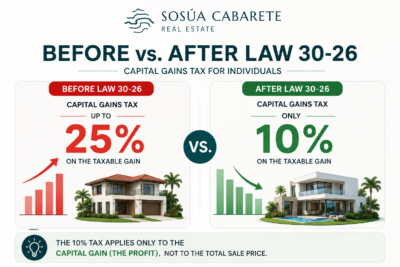
Capital Gains Tax Reduced from Up to 25% to 10%

This is the most important change for many property owners.
Before Law 30-26
Individuals selling real estate could pay up to 25% in capital gains tax.
After Law 30-26
The tax is now a flat 10% for qualifying individual sellers.
This represents one of the largest tax reductions for personal real estate transactions in recent years.
The 10% Tax Is NOT Calculated on the Sale Price
One of the biggest misconceptions is that sellers will pay 10% of the entire selling price.
That is incorrect.
The 10% applies only to the capital gain, which is calculated as:
Selling Price – Inflation-Adjusted Purchase Cost = Taxable Capital Gain
This distinction is extremely important.
Example
Suppose you purchased a property several years ago for US$150,000.
After adjusting the acquisition cost for inflation, your adjusted basis becomes US$170,000.
You later sell the property for US$220,000.
Your taxable capital gain is:
- Selling Price: US$220,000
- Adjusted Cost: US$170,000
- Capital Gain: US$50,000
The 10% tax applies only to the US$50,000 gain, not the full US$220,000 sale price.
Understanding this calculation helps many sellers realize the new law is far more favorable than the headlines suggest.
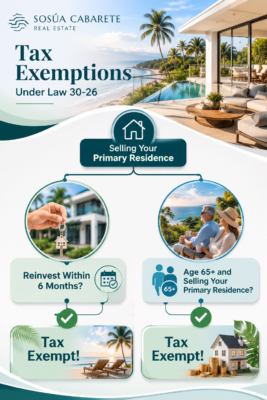
Two Important Capital Gains Tax Exemptions
Law 30-26 also introduces situations where qualifying individuals may pay no capital gains tax at all.

1. Reinvesting in a New Primary Residence
If you:
- Sell your primary residence
- Reinvest 100% of the proceeds
- Purchase another qualifying primary residence
- Complete the reinvestment within six months
you may qualify for a full exemption from capital gains tax.
For families upgrading or relocating within the Dominican Republic, this can represent substantial savings.
2. Homeowners Over Age 65

Another significant benefit applies to seniors.
Individuals 65 years of age or older who sell their primary residence may qualify for a complete exemption from capital gains tax, even if they do not purchase another home.
This provision offers valuable flexibility for retirees who wish to downsize, relocate, or simplify their financial affairs.
Is the 3% Property Transfer Tax Eliminated?
No.
This is one of the most common misconceptions circulating online.
The 3% Real Estate Transfer Tax, which is generally paid by the buyer at closing, remains in effect.
Buyers should continue budgeting for this closing cost when purchasing property in the Dominican Republic.
What Tax Is Actually Being Reduced?
Some confusion comes from a different tax.
Law 30-26 gradually eliminates a 2% unified ad valorem tax that applies to certain transactions.
The schedule is:
- 2026: 2%
- 2027: 1%
- 2028: Eliminated
This reduction is separate from the traditional 3% property transfer tax.
What Does This Mean for Foreign Buyers?
International buyers considering property in Sosúa, Cabarete, or Puerto Plata should know that Law 30-26 primarily affects taxation when a property is eventually sold.
It also creates a more favorable environment for individuals who own property personally rather than through a corporation, although every situation should be evaluated individually with legal and tax professionals.
Why This Matters for Property Owners in Sosúa and Cabarete
The North Coast continues to attract:
- Canadian buyers
- U.S. investors
- European retirees
- Vacation home buyers
- Digital nomads
- Rental property investors
A lower capital gains tax can improve long-term investment returns and encourage more property transactions.
For many owners who delayed selling because they feared excessive taxation, the new law may provide an opportunity to reconsider.
Frequently Asked Questions
Does everyone pay 10% capital gains tax?
No. The 10% rate applies to qualifying individual sellers. Different rules may apply to corporations and specific circumstances.
Is the 10% charged on the property’s sale price?
No.
The tax applies only to the capital gain after adjusting the acquisition cost for inflation.
Has the 3% transfer tax been eliminated?
No.
The buyer’s traditional 3% transfer tax remains unchanged.
Are retirees eligible for special tax benefits?
Yes.
Individuals over 65 who qualify under the law may be exempt from capital gains tax when selling their primary residence.
Should I seek professional advice before selling?
Absolutely.
Every property transaction is unique. You should always consult a qualified attorney or tax advisor before making financial decisions based on the new legislation.
Our Professional Advice
At Sosua Cabarete Real Estate, we closely monitor legal and market developments so our clients can make informed decisions with confidence.
Whether you’re buying your first Caribbean home, selling an investment property, or planning retirement in the Dominican Republic, understanding the latest regulations can help you maximize your investment while avoiding costly misunderstandings.
Thinking About Buying or Selling Property in the Dominican Republic?
Our experienced team specializes in helping international buyers and sellers navigate every step of the process—from property selection and negotiations to closing and relocation.
Contact Sosua Cabarete Real Estate today for personalized guidance on buying, selling, or investing in property on the North Coast of the Dominican Republic.
Disclaimer
This article is provided for general informational purposes only and should not be considered legal or tax advice. While every effort has been made to ensure accuracy, laws and regulations may change, and each situation is unique. Before buying or selling property, consult a qualified Dominican attorney or tax advisor regarding your specific circumstances.